Introduction
As humans continue to dominate landscapes around the globe, with a total population nearing 8.5 billion (Population Clock 2025) and urban centers expanding rapidly (Angel 2023), the ecosystems around us are facing worsening threats from a multitude of compounding sources. As a result of these anthropogenic pressures, global biodiversity has exhibited rapid decline in the past several decades (WWF 2024). This trend is projected to worsen in the coming years, which threatens the stability of our own communities through the decline of critical ecosystem services (Wang et al. 2025), the unbalancing of trophic cascades and ecosystem-wide functional niches (O’Gorman et al. 2010), and the loss of the innate value of non-human species.
Many human-centered factors threaten wildlife populations in particular, through processes like habitat loss and fragmentation, urban expansion (leading to increased human-wildlife conflict), pollution, the introduction of non-native species, overextraction (unsustainable hunting and fishing), and the spread of diseases from humans and domesticated animals (Kuiken & Cromie, 2022).
Although all taxa are important to ecosystem balance and global biodiversity, mammals present a somewhat unique case for a number of reasons. Many mammal species are large-bodied, meaning that they require large habitats and abundant, diverse resources (Ripple et al. 2014). This can make them especially vulnerable to anthropogenic threats. Mammals also tend to occupy higher trophic levels, increasing the likelihood that they function as keystone species on which most other species in that community rely (Ripple et al. 2014). They may also be at higher risk for human-wildlife conflict and disease transmission, due to their behavioral and genetic proximity to people (Shivaprakash et al. 2021). And finally, despite all of these heightened risk factors, mammals are also the easiest to garner support for in a conservation context. Because of their charismatic appearances, funding and public support are typically greater than for many other taxa (McGowan et al. 2020), which means that mammals are both critically important to protect and represent a somewhat achievable conservation target.
Below is a figure from Gaynor et al. (2018), published in Science, that illustrates the impact of human disturbance on mammalian activity patterns. Although this is just one example of anthropogenic influence on wild mammal populations, it highlights the need for a deeper understanding of the specific mechanisms driving mammalian changes and risk factors.
Thus, for all of the reasons outlined above, understanding the factors that influence mammalian extinction vulnerability is critical.
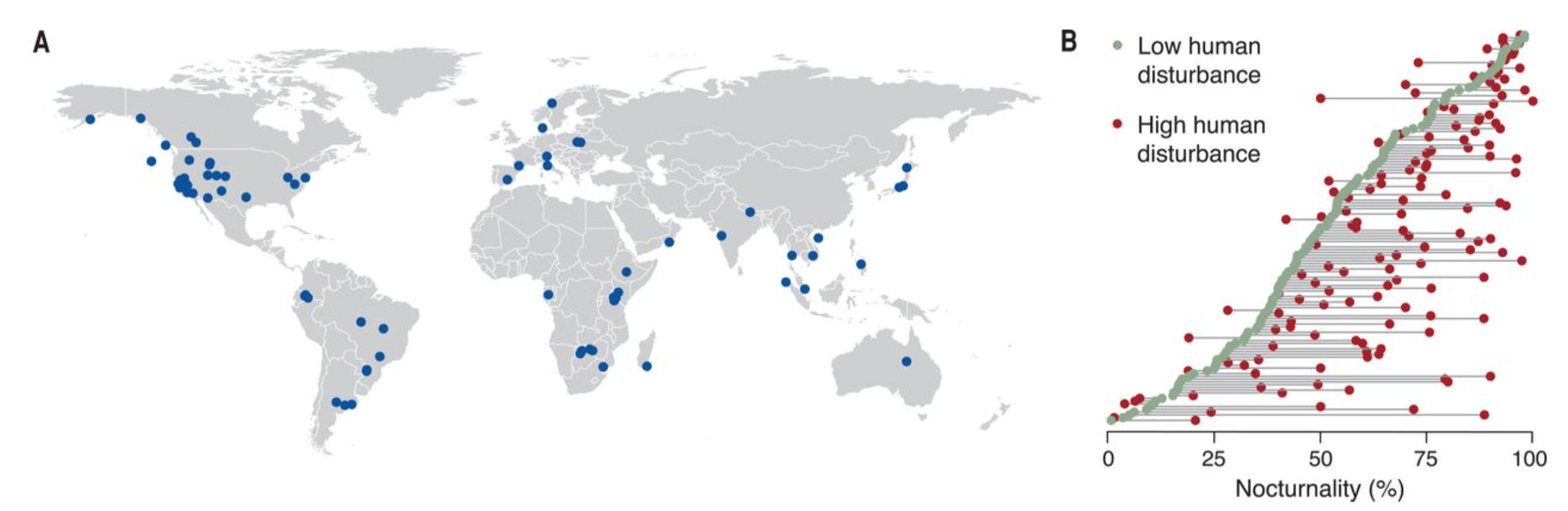
Figure 1. From Gaynor et al. 2018. A) Map illustrating the locations of the 76 studies included in the meta-analysis. B) Paired measures of nocturnality (percentage of activity that occurs in the night) in areas of high human disturbance (Xh) and low human disturbance (Xl), displayed for each species in each study (n = 141 effect sizes, ordered from high to low Xl). The relative change in nocturnality in response to human disturbance was used to calculate the effect size (RR) for the meta-analysis, where RR=ln(Xh/Xl).
Although many metrics of anthropogenic impact have direct implications for wildlife, measures of human population, land conversion, and human-mediated invasive species have the potential to serve as key proxies for many other anthropogenic effects, together highlighting some of the greatest human threats to global wildlife populations. As such, these are the variables focused on in this analysis.